It does not soften the reality of temptation, nor does it pretend that sin appears ugly on the front end. Instead, Scripture names what we all know to be true but often resist admitting: what is forbidden can be alluring, persuasive, and sweet for a moment. The danger is not that temptation lies to us—but that we listen.
This chapter is a father’s warning to a son, and it is plainly about adultery. The language is not symbolic at first glance. It is direct, practical, and grounded in real-life consequences. The adulterous woman is described as smooth-talking and desirable, but the end of that path is bitterness, loss, and regret. Wisdom is not abstract here; it is painfully concrete.
One of the most striking elements of Proverbs 5 is that regret is given a voice. After the damage is done, the speaker looks back and mourns not just the sin itself, but the refusal to listen when instruction was available. “I hated discipline, and my heart despised reproof.” The tragedy is not ignorance—it is rejection of wisdom that was already offered.
What stands out to me is that Scripture does not condemn desire. In fact, Proverbs 5 does the opposite. It celebrates desire rightly ordered. Faithfulness within marriage is described as joyful, intoxicating, and life-giving. The problem is not passion—it is passion detached from covenant. God’s wisdom does not call us away from love or intimacy, but toward a love that is protected, exclusive, and enduring.
Marriage is treated with such gravity here because it is not merely emotional or contractual—it is covenantal. To violate that covenant is to invite destruction, not because God is withholding joy, but because He is guarding it.
Later in Scripture, we will see this covenant language deepen. The marriage relationship becomes a picture used by God to describe His faithfulness to His people and His people’s faithfulness—or unfaithfulness—to Him. Israel’s idolatry is called adultery. The Church is described as the Bride of Christ. But it is important to recognize that Proverbs 5 is not making that theological argument explicitly yet. This is wisdom literature dealing first with obedience in daily life.
Still, the echo is there. Human covenant faithfulness matters because it reflects something greater. The way we treat covenant—with God and with one another—reveals what we believe about trust, loyalty, and love. Faithlessness in marriage and faithlessness in worship are not identical, but they grow from the same root: a refusal to trust God’s design over our own desires.
Proverbs 5 ultimately teaches us that sin promises freedom but delivers regret. Wisdom, on the other hand, may feel restrictive in the moment, but it preserves life, joy, and peace. God’s warnings are not threats; they are acts of mercy. He speaks before the fall, not after, because He loves us.
The question this chapter presses on my heart is not simply, “Will I avoid obvious sin?” but rather, “Will I listen while instruction is still being offered?” Regret speaks loudly in Proverbs 5—but wisdom was speaking first.
Obedience now is a kindness to our future selves. And correction, though uncomfortable, is one of the clearest signs of God’s love.
Proverbs 4 does not stand alone; it is a continuation of the invitation begun in Proverbs 3. If Proverbs 3:5–6 establishes the heart posture—trusting the Lord with all your heart, leaning not on your own understanding, submitting to Him—then Proverbs 4 shows us what that posture looks like lived out with our feet on the ground.
The wisdom of Proverbs 4 is not abstract. It is directional.
“Let your eyes look straight ahead;
fix your gaze directly before you.” (Proverbs 4:25)
This is not a call to self-focus or personal determination. It is a call to fixed attention—eyes no longer darting between competing voices, desires, or fears. The straight path only remains straight when our eyes are fixed on the One who defines it. Proverbs 3 tells us who we trust; Proverbs 4 tells us how we walk once we do.
The narrowness of the path is intentional. Scripture never presents wisdom as the easiest way—only the right one. Jesus echoes this same truth when He teaches that the gate is narrow and the way is hard that leads to life, and that few find it. This narrow path is not narrow because God is withholding; it is narrow because it is guarded. Guarded from the chaos of self-rule. Guarded from the deception of the flesh. Guarded from paths that feel right but ultimately lead to destruction.
This is why Proverbs 4 warns us not to turn to the right or the left. Deviation rarely begins with the feet—it begins in the heart. When wisdom loosens its hold on us internally, our steps soon follow externally.
That is why the command to guard the heart sits at the center of the chapter:
“Keep your heart with all vigilance, for from it flow the springs of life.” (Proverbs 4:23)
Scripture consistently affirms this truth: the heart is the source, and the rest of life is the overflow. Jesus Himself teaches us that what fills the heart will inevitably make itself known when He says,
“For out of the abundance of the heart the mouth speaks.” (Matthew 12:34)
Our words are not accidental. They are not random. They are reveals. What overflows from the mouth first took root in the heart—whether wisdom or folly, trust or fear, submission or self-reliance. Jesus reinforces this again when He explains that a good person brings forth good out of the good treasure stored in the heart, and the opposite is equally true.
This is why Proverbs is so insistent that the heart be guarded above all else. If the heart is left unkept, the mouth will testify to it. If the heart is shaped by wisdom, the fruit will follow.
Here is where Proverbs 3 and Proverbs 4 meet so beautifully. Trusting the Lord with all your heart is not passive. It requires attentiveness, humility, and daily surrender. Fixing our eyes straight ahead is not about strength of will—it is about submission of sight. Whom we look to determines where we walk.
And the promise woven throughout Scripture is this: when our eyes are fixed on the Lord, when our hearts are yielded to His wisdom, and when our steps follow the narrow way—He makes the path straight. Not always easy. Not always comfortable. But always good.
I think I’ve found a new motivational motto. I learn so much from the way God created nature, I learn about Him and His attributes and I learn about me too. I learn how not to handle things sometimes, and how to handle things. Recently, I was having a discussion with my son about leadership and knowing what to do and how to do it and how sometimes not acting on what you know needs to be done because of the anticipation of how others will respond causes us to retreat back into ourselves. I softly reminded him that James encourages us to be doers of the word not just hearers, posters, and knowers (paraphrased with emphasis added) and we should be applying that to everyday life.
One of our former youth students who is now grown with kids of her own tagged me in a post on Facebook not too long ago about growth. It said something to the effect of just because I did it or advocated for it in the past and don’t participate in it or advocate for it now, doesn’t make me a hypocrite when I advocate against something I once did or advocated for. It means I’ve grown. She was struggling with people in her circle accusing her of hypocrisy because she had grown and matured and dared to change her stance on some things.
We were on a grand adventure last week with the pups and saw a sign that said “do the best you can until you know how to do better,” we had a discussion about that being a viable replacement for the saying, “fake it until you make it.” Do the best you can until you know better, when you know better, do better!
These all encapsulate the idea of Forever Forward. I won’t speak for everyone, even though I’m pretty sure we have all stopped ourselves from doing something at least long enough to consider what others will think, I’ve done it far too many times to count. I’ve listened to others’ opinions when I should have trusted my gut. Sometimes, especially in a small town where people have known you your whole life, or in a family where people have seen you grow up they can form a mental model of you that they cling to even when you mature and change, this can be true with both good changes where you have worked hard to grow yourself in areas and mature but they see the little boy or girl or rebellious teenager, etc. they THINK they’ve always known. The converse could be true too, its possible to ride the coattails of your previous character even around people who don’t spend enough time around you anymore to know you don’t live by the standards you previously did. But that’s another story for another day.
It is with these thoughts in our heads sometimes that we retreat within ourselves because we fear the backlash, lack of support, misunderstanding, or even sometimes revealing that we are capable of doing far more than we have been, and so raising expectations for ourselves in the minds of our peers. This can also come with some backlash of “why haven’t you stepped up before now?” We remain paralyzed, rooted in our fear, whether reasonable or not, and don’t move. We do nothing, we allow what WE THINK others may think, or how WE THINK others may respond, to control OUR OWN lack of growth. WE ALLOW IT, which means, WE CHOOSE IT. If we are a victim, it is only because we chose to be ourselves. Refuse to be a victim. You’ll never get where you want to be with that mindset.
My son was talking with me through some of his struggles and I was sharing some of my own and he reminded me then, just like he did the other day, when I was again struggling, that I always have a tendency to value too heavily what others think or what I think they will think, but never when it pertains to something about faith because I fear God more than any man. I started looking at how to uncompartmentalize that aspect of my faith and inject it into my daily life.
If I was a betting woman, I would bet money that in 1519 when Hernan Cortes landed on the shore of the “New Land” and instructed some 600 men to burn the ships as they advanced on the Aztecs to conquer what is now Mexico, that his men thought a lot of things and not all of them were positive about their leader! But Cortes was ensuring there would be no retreat. If you sat paralyzed in fear, you would die. His motto was clearly, forever forward.
A nautilus, one of God’s beautiful ocean creatures, grows in this same way. Forever forward regardless of what happens. Each chamber is sealed off behind as the nautilus grows, and it does not retreat to the first and earliest or any of the chambers of it’s shell that it once inhabited. Mistakes or not, good or bad it grows always moving forward. When my son was in MMA many years ago his coach would say, “we never lose, we can win or we can learn.” That’s a forever forward motto too. The illustrator of what is about to be 3 of our children’s books painted herself (below) on the shore of our first book because, whether she realizes it or not, she also is the embodiment of growing forever forward and glorifying God regardless of the circumstance she finds herself in. She is as brave a warrior as Cortes himself and I’m grateful to battle by her side as well as my daughter’s who also is the embodiment of forever forward too. She never lets what would shut most people down even really cause her to stumble.
So whatever it is that’s holding you back, especially if its hypothetical thoughts in your own head, its time to burn your ship, seal off your chamber, you know better now do better, grow! One of my very best friends hand painted a treasure for me that I hang wherever we go. It’s a serving tray painted with aspens in vibrant fall colors. At the time she gave it to me she was moving, and I was too focused on that to notice or understand the weight of the word, “Grow” that she included along the outer edge. So many times, when we’ve been doing hard things and experiencing pain, I’ve looked up and seen that word and felt its comfort wash over me. GROW! I used to have terrible growing pains in my legs as a child and I welcomed them because I wanted to be tall! The struggle you’re feeling is growing pains, keep moving forward, don’t retreat! Grow-FOREVER FORWARD
I’m tagging along on a business trip with my hubs because he’s going to be relatively close to a good friend I haven’t seen in ages! As we do when he and I are on roadtrips, we picked a book to listen to. I had downloaded Jon Acuff’s “All You Need Is A Goal,” since it had been referred to me by my bestie.
There’s the link in case you’d like to get your own copy, I do earn commissions from Amazon from my referral links.
Anyhow, the first exercise he instructs readers to do is create a best moments list. He goes on to list some of his own best moments as well as others so there are ample examples of what those could look like. He even talks about the difficulty in focusing on yourself enough to call attention to some of your accomplishments as you recognize them as best moments. Not all best moments are accomplishments. Later you’ll categorize these moments into 4 different categories: experience, accomplishments, relationship, & objects.
This will not be a book review, it’s the doing of this exercise that captured my attention from a mental health standpoint.
As Shaun and I began to form our lists audibly calling out loud our best moments and reminiscing there were tears, smiles, laughter and joy. Jon said the 40’s hit a little different and are characterized by self reflection which I find to be true.
Today has been a gray day and it sputtered rain off and on all day. This is the typical kind of day that usually gets me down and blue, but this exercise made me really focus on so many of the good and wonderful moments I’ve had in my life. It’s very difficult to be gloomy when you’re focusing on those moments and literally writing them down on a piece of paper that you can stare at. It’s very difficult to ignore the truth you’re very plainly listing out and continue in false and dark thoughts attempting to consume your mind.
I listed things like
-meeting my husband,
-getting to be pregnant 3 times
-having 3 beautiful babies!
-The sound of our children’s laughter even as adults especially when we’re all together.
-Our first trip to CO and every trip since that allowed us to meet some of the most incredible people who have become family and not just friends.
-Specific hunts
-our Little Buddy
-Frankie the Tortoise
-church camp 2018
-publishing my first book!
-and so on!
My list is soooooo long and it’s hard for me to continue to be blue with all of these clearly wonderful moments staring at my face! This will be an exercise I employ when I feel myself being blue, and it’s one you can use too.
As a believer, I have long known the expression “count your blessings” which makes me think of the song and then the following lyric “name the one by one.” This isn’t a new tactic, clearly it’s been in use awhile!
Further, I’ve long learned to employ the verse about taking my thoughts captive in 2Corinthians 10:5 and forcing them to be obedient to the will of a Christ. To turn them from gloom and despair to what Paul suggested us to focus on in his letter to the Philippians,
Philippians 4:8 (NASB95): Finally, brethren, whatever is true, whatever is honorable, whatever is right, whatever is pure, whatever is lovely, whatever is of good repute, if there is any excellence and if anything worthy of praise, dwell on these things.
Sometimes hearing that and doing it are two separate battles and trying to use it to reprogram your thought processes can be just as tough. This exercise however, is a simple one that set me on the right path today. I know that all good things come from my Father above, so if I’m listing out blessings, that’s focusing on lovely things that are worthy of praising our Father about.
If you’re struggling with depression, what could it hurt to grab a pen and paper and start listing some of your best moments, any favorite memory. You’ll see that the truth, and what you’re feeling, aren’t in alignment right now and you need to continue to focus on these “bests” to have them help you reprogram your “stinkin thinkin.” This worked for my stinkin thinkin today!!
The next book I listen to will be “Don’t Believe Everything You Think” by Joseph Nguyen https://amzn.to/3OeRJHE and I’ll see if there’s anything practical and helpful I can use and share with others in there!
When I’m in my feels I write, it gives me something productive to do instead of just cry.
Over the last 2 years we’ve done a lot of waving and hugging bye and it still hasn’t gotten any easier, and nothing prepares you.
Nothing really prepares you for the vacancy at home, For waking up to an empty house and being all alone.
The missing sound of tiny feet and all the chatter being gone. Driving away after holidays with empty seats just feels wrong.
Nothing prepares you for leaving them behind, or watching them drive out the driveway to go back to their home, or the feeling that poisons that last day together knowing tomorrow you’ll wake up empty and alone.
Nothing prepares you for the tightness in your chest and the invisible hand around your neck. Just when you think you’ve got the battle won and you can make it, the memories flood back!
The tears cloud your vision at random times in the day, and the pain that comes with missing them dulls but never goes away. It’s not as though they’re completely gone, you’ll see them again, you’ll arrange vacations and visits and burn up the FaceTime calls until you’re back together with them.
The time is never long enough, you hate for them to leave. No one really prepares you for your bigs to grow up or the way it makes you grieve. When the first ones out you begin to grieve the others if they’re close, even though they’re still at home you know all of them leaving will hurt the most. You learn to treasure the moments and the time that you have left, you hold them a little tighter and hug a little longer and don’t explain your eyes when they randomly become wet. Nothing can prepare you for the way letting them grow up feels, even though you know it’s the right way you, just long for those big sit down family meals.
The laughter around the table now is a balm that heals your soul, and the pile of shoes and chaos that maybe used to bother you is let go!
Nothing really prepares you when all of you grow old, maybe something will come along and ease the ache someday like a grand baby to hold.
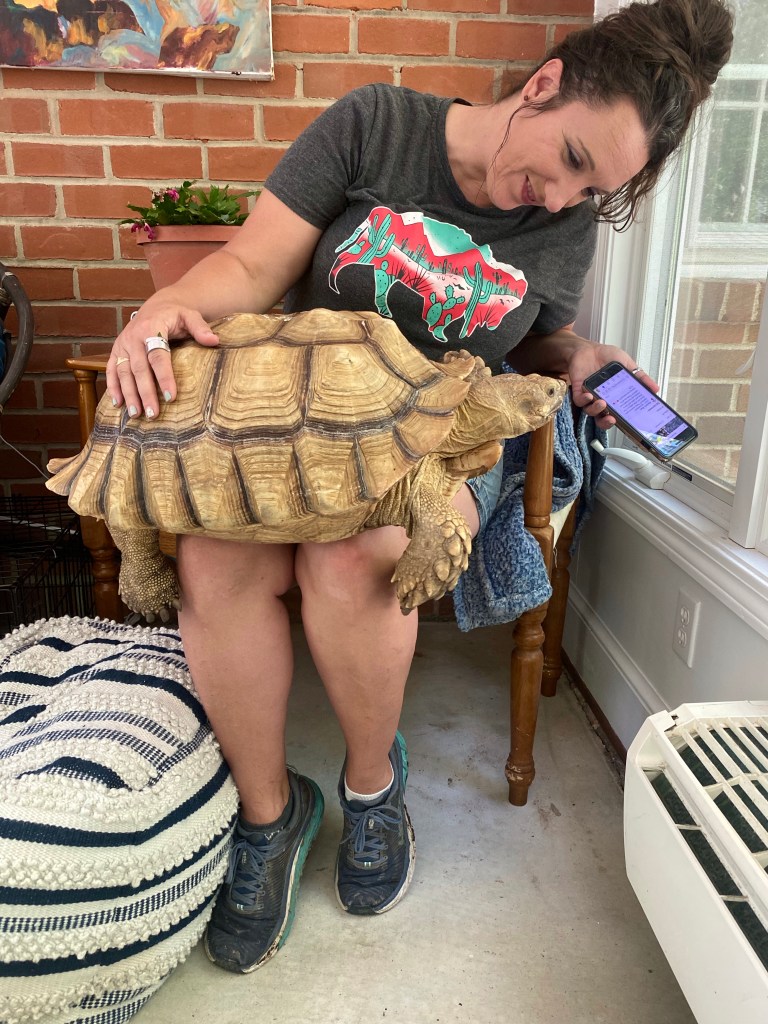
At this point the world knows I have a 60 pound escape artist of a tortoise! He’s escaped at our home in Texas and he’s escaped at our home in Virginia. The first time he escaped it was completely my fault, I left the gates open! Future escapes have been because he’s strong, or major rain events have caused deterioration to his pen, or something on his pen broke or wore out like this last time. Sometimes it takes us a bit to figure out what we need to fix. As a result he’s now outfitted with a tracker!
There’s always tears and heartache when I lose Franklin. This time was no different. He was gone for 6 days and I cried every one of them. I searched every single day even in the rain knowing the weather was too cool in the evenings for him to go too far or move too much. He was ultimately found less than a half mile from the house by the sweetest girls who were just as elated at having found him an reunited him with us as we were that they found him and he was safe and sound.
I realized while taking steps to ensure we don’t have to go through this heartache again that there was something far more beautiful that has happened each time Frankie has been found.
In our community in Texas and in our community here in Virginia when the trumpet blast was sounded via social media, word of mouth, and text or phone calls, the community sprung into action to help us. When people you don’t know, have never met, and maybe never will, take the time to not only share your post, but to physically go out and walk the neighborhood, to message or comment words of encouragement and let you know they’re praying it ads dimension to the relief of finding Frankie. This is the beauty of community! God created us in His image which includes living in relationship and community together with Him but also with each other.
Finding Frankie in Texas and Virginia has come with its beauty and relief but seeing communities come together to support us in both of those places has been so much more beautiful. Honestly, we were longing for the same type of connection to our new community here in Virginia that we have in Texas. Finding Frankie helped us to see the beauty of this precious community and see with new eyes the joy of connecting to others in it.
I can only imagine what life was like in the early church in Acts chapter 2 as they daily met together and broke bread in their homes and shared their meals and “God added daily to their numbers those who were being saved!” Acts 2:47
Community, connection, unity is important, Paul writes about having the same mind in Philippians 2 loving one another and being united in spirit intent on one purpose. Specifically, he even noted to consider others interests as important as your own.
Our community considered my interests in Finding Frankie. They demonstrated love to us and we are so grateful to be a part of them, but also to see God’s word more clearly as we think about living in community and being united in one spirit intent on furthering the gospel.
This may mean sacrificing my time, my wants, my preferences so that someone else will come to know Jesus as Savior and King. As I reflect on how our community responded in love to help us find Frankie, I also reflect on God’s word and purpose for our lives and the tenacity with which he leaves the 99 to find the one lost (Matt 18 and Luke 15) and hope that we demonstrate that same zeal for sharing the gospel with the lost!
When I was in Junior High and early high school I didn’t really like working in groups, I was always nervous to have to rely on someone else’s work for MY grade. Usually, I would just do all of the work and turn it in for us to ensure an A. I’m not sure if I would have come out then and said that I thought I was smarter or just that I had trust issues. When I was in the last couple of years in high school, the group I interacted with academically often challenged me. I’ll never forget the first time I got to choose my own group and came out with Prem, Alan, and Amanda and we sat down to talk about the project and what needed to be done. These 3 actually graduated valedictorian, salutatorian, and high honors of our class. Prem and Alan were literally the smartest people I knew at the time and Amanda was probably the most creative when it came to meshing ideas together and making them flow. We each pulled our weight and brought something different to the team. We each taught each other new things. This challenged my early idea of group work. I realized I didn’t have to be the smartest person in the room, our grades together were actually better than when I took over and did it all myself. Sure, the work was done but it could have been so much better. I realized that I just needed to be able to locate the people who were gifted in the areas I was not, or who were just smarter than me all together. I don’t have to be the smartest person in the room or on the team, I need people who know more than me!
This strategy worked well for me all through college, sometimes I got to choose my groups and sometimes I was assigned them. EVERYONE has something contribute, so everyone can contribute somehow in a way that someone else wouldn’t. It just takes getting to know your team, and figuring out what that is!
In the last two weeks I have encountered two situations, one involving a new Christian and the other a non-believer. In both of these situations, they were conversing in a group of people they felt like were definitely “smarter” than them where the Bible was concerned. One conversation was over translations of the Bible among what was clearly seminary trained or well-studied adults. The new believer described this experience like “friendly fire” as they each made their case for their favorite Bible translation and why. The new believer was just happy to have a Bible and be able to understand it finally. She didn’t really understand why a group of Christians was essentially arguing with each other over reading the Bible!
When I was younger the only translation, we had in the house was a King James translation and I used to try to read it but then always ended up acting like an actor in a Shakespeare play and heralding what I was reading rather than actually comprehending it. Then, when I was 13, I received a Youth Walk devotional Bible which was probably an NIV translation, maybe ESV but my money is on NIV (I lost it in a wreck in my 20’s). Anyhow, I remember thinking, “OMG, this is in English!” It was the first Bible I had actually been able to read and understand.
I’ve seen that scenario play out plenty of times teaching youth over the past 10 years. When I went to seminary and was taking Hermeneutics, I learned about the different Bible translations, but my professor equated them not only with how they were translated, word for word, literal, or thought for thought, etc. He also explained them with reading and comprehension in mind and gave us suggestions when understanding who we were providing the Bible to.
While I do have a favorite translation I personally read from, I read from my paper NASB 77 but my electronic NASB 95, because I prefer a word for word translation of the original text, but that’s not usually my “go to” recommendation for kids! Really the biggest one I absolutely stay away from is “The Message” translation and others that are thought for thought translations because that means the passage has been interpreted by a human and translated into what they believe the thought of the writer was. Now, my husband can be thinking and say something to me, and I react in a way that makes me want to throat chop him, as we talk it out, what I heard and what he was thinking when he articulated were two very different things and I end up not being upset at all. I’m fallible, I make mistakes and misunderstand. Because we understand that the Bible was written under the inspiration of the Holy Spirit guiding the human men’s hands along that physically penned the words (2Peter 1:21), we understand the author to be God. We know that God is perfect, does not make mistakes, and never fails. So, I prefer to leave someone else’s thought process out of the translation process into my language when it comes to interpretation. I prefer the most literal word for word translation I can read. This doesn’t mean I never pick up an NIV or ESV or even a CSB, I actually have a CSB apologetic out now, because I sometimes get to a difficult passage and need to hear some of the other translations as I began a word study.
All of this to say, the smartest people in the room that day, who have a valid point about Bible translations, participated in a conversation among people that left at least one new believer for sure, feeling overwhelmed and like she was reading an inferior translation to what “the scholars” read but not being able to understand them fully, they ended up detracting from her discipleship rather than encouraging her. Fortunately, this time, I didn’t participate in this particular conversation, but unfortunately, I can recall times I’ve discussed something similar and probably did make someone feel this way.
The other scenario was a conversation in front of and with a non-believer about questions he had but that lead to different denominational practices. Fortunately, the Holy Spirit swooped in an arrested my thoughts and tongue and directed me to focus on what I would call “Primary Doctrine,” that of how it is we come to faith in Jesus as Savior and King. In this instance, two of us having the conversation believed rightly the same thing about Jesus and had already repented of sin and believed the gospel of Christ, placing our faith in Jesus. The discussion was beginning to take a turn towards certain ways we practice our faith, such as speaking in tongues and if that means a language of a tribe or nation of peoples or a spiritual language that also requires a spiritual interpreter. There are people who are on both sides of the fence on this one. This wasn’t a discussion that was going to be helpful at the moment to a non-believer who wasn’t the one who asked that question but had asked other questions trying to understand a basic Biblical metanarrative (big idea of the Bible). The Holy Spirit steered us away from having a debate and towards talking about Jesus’ death burial and resurrection and that He is the answer to all the brokenness and hurting in the world. God has done something about it, He sent Jesus, and in His grace and mercy we are given time to come to repentance and faith!
I have to admit I haven’t always yielded to the Holy Spirit in these matters. I mean it’s not like it’s wrong to talk these things out with others and have a spiritual conversation, right? TIME AND PLACE! When that conversation takes place in front of a person or people who are new to the faith or unbelievers, and they see it as more of a debate, it can actually detract rather than build. Unfortunately, I’ve been guilty of this before, and I’ve also seen it happen. When I was in seminary, I got comfortable around my “bubble” of “little theologians”, and we were made to discuss these things regularly amongst each other. The same “debates” shouldn’t take place in all settings. Especially if you’re just trying to prove that you are as smart as the guy next to you. Those “bubbles” can be dangerous, especially for people in leadership positions in a local congregation, there’s a difference in educating and equipping the people you have the privilege to encounter and making them feel like you’re the smartest person in the room and the only one capable of rightly sharing the gospel to lead someone to Christ or for continued discipleship. Jesus commissioned all believers to do that, not just the seminary educated ones, pastors, scholars, or other church staff. “If you know enough to be saved, you know enough to lead someone else to Christ,” after that you can learn together! We ALL have something to contribute, don’t let someone make you feel inferior or uncapable to share the gospel and disciple! We are all “little theologians” whether we do it in seminary or home, or church, we are all studying God and His Word! Your pastor may have more experience speaking to groups or people due to his “job” and his “professional training,” but the same Holy Spirit that lives in him lives in you and you are completely capable of learning and sharing!
If you are usually the smartest person in the room, and especially if you feel the need to prove you’re the smartest person in the room, find a new room! Recognize how that may make others feel especially if your end goal is to participate in study or conversation that equips and grows both you and the people around you. Recognize you can learn something from everyone. I might spell or write better than my hubby, but he can outperform and outthink me mechanically, physically, and leadership wise, honestly, he’s better at loving me than I am him too! We are smart in different ways, together we are better! When we are with people, lets untether ourselves from the worldly idea of competition and seek to learn from each other and bring our best to build and grow together regardless of our experience or education levels!




 Raychel Writes