Proverbs 3 has always been familiar, but today it felt deeply personal.
Proverbs 3:5–6 has long been an anchor verse for Shaun and me. It’s one we return to often, and one I’ve written in countless farewell letters to people we’ve sent out—because it reminds me of something I desperately need to remember:
my own ways are not trustworthy.
Left to myself, I can reason well, justify well, and still end up off course. Trusting the Lord—fully, humbly, without reservation—and walking in obedience to Him isn’t optional if I desire an upright life.
It’s essential.
What struck me anew in this chapter is the intimacy the Lord shares with the upright. Scripture tells us that the Lord is intimate with those who walk rightly before Him, and I find myself longing for that closeness—not because it makes life easy, but because He is so good.
His nearness is not earned by perfection, but enjoyed through surrender.
Proverbs 3 also speaks about the Lord’s correction, and I’m grateful that it does not shy away from it. Correction is not a contradiction of His goodness; it is an expression of it.
When God corrects, it is never harsh, never careless, and never disconnected from love. Even when it’s uncomfortable—even when it humbles me—it is always for my good.
I see this so clearly through the lens of parenting. We correct our children not because we delight in their discomfort, but because we love them too much to let them continue down a path that will harm them.
In the same way, the Lord disciplines those He loves. His correction is evidence of relationship, not rejection.
Proverbs 3 reminds me that wisdom, trust, obedience, intimacy, and correction are not separate ideas—they are deeply connected.
To trust Him is to submit to Him. To walk uprightly is to remain close to Him. And to accept His correction is to rest in the truth that His heart toward us is always good.
Today, my prayer is simple:
Lord, help me trust You more than I trust myself. Help me welcome Your correction. And help me walk uprightly—not to earn Your love, but because I already have it.
Proverbs 2 doesn’t treat wisdom as optional or passive.
It doesn’t say, “If wisdom happens to cross your path…”
It says receive, treasure, incline your ear, cry out, lift your voice, seek, search.
This chapter shows us the intensity with which wisdom must be pursued—with the same intention and consistency as someone mining for silver. Not a casual stroll. Not a once-a-week glance. But digging. Reaching. Returning day after day because what’s buried is worth the effort.
And Scripture is honest here:
If wisdom is not actively sought, something else will fill the gap.
The absence of wisdom doesn’t leave us neutral—it leaves us vulnerable. Vulnerable to crooked paths, distorted desires, and voices that sound convincing but lead us away from life.
Proverbs 2 also shows us something tender and reassuring: wisdom protects before it corrects.
When we seek it, wisdom guards our steps, sharpens our discernment, and keeps us from paths we don’t yet recognize as dangerous. It doesn’t just tell us what’s right—it keeps us from falling into what would cost us peace, integrity, and joy.
And here’s the promise woven through the whole chapter:
When we seek wisdom earnestly, the Lord gives it.
Not reluctantly. Not sparingly.
He delights to give understanding to those who ask—and He uses it to preserve, guide, and anchor them.
Wisdom is not merely knowledge.
It is protection.
It is clarity.
It is a kindness from God for those who are willing to dig.
Every January, I try to start the year the same way—anchored in wisdom from the Word. One chapter of Proverbs a day. One month. Thirty-one chapters. A reset for my heart and mind.
Today I started with Proverbs 1, and what stood out to me is how clearly God defines wisdom from the very beginning.
Wisdom begins with a proper fear of the Lord—not fear that runs from Him, but reverence that submits to Him. It’s choosing obedience over impulse. Truth over temptation. Discernment over distraction.
Proverbs 1 also gives a loving but sobering warning: Don’t desire evil. Don’t run with people who do. Not because we’re better—but because sin always costs more than it promises.
What really struck me is how wisdom is described as calling out—loudly, clearly, publicly. God isn’t hiding truth. He isn’t whispering it in secret. Wisdom is right in front of us… but some choose ignorance instead. Not because they can’t see—but because they won’t turn.
If you’re looking for a simple way to begin the year grounded in truth, I encourage you to read Proverbs 1 today. As you do, ask yourself:
Am I truly fearing the Lord, or just acknowledging Him?
Are there influences I need to flee instead of justify?
Where has wisdom been calling—and I’ve been ignoring it?
God is faithful to give wisdom to those who ask and walk in humility. Let’s start the year listening.
I don’t know if it’s just me, but this season feels extra full. Between family, my oldest son’s upcoming wedding (9 days! 😳), the holidays, and all the writing projects that have been stacking up, I’ve found it harder and harder to sit down and write here — in this space that started it all.
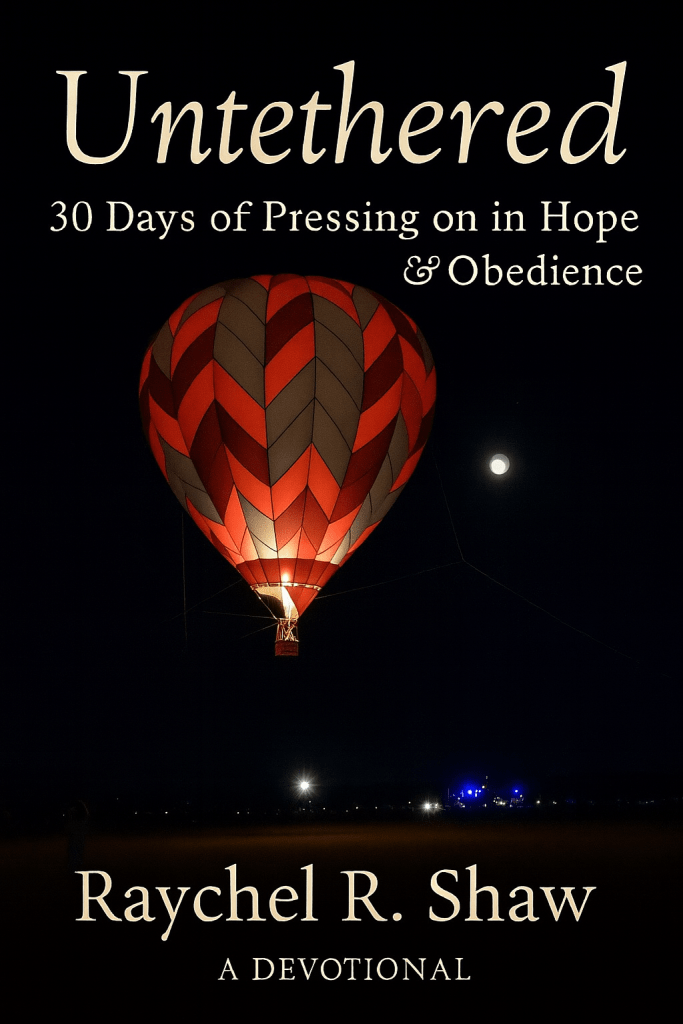
When I began blogging, it wasn’t for likes or algorithms; (still isn’t) it was a way of processing what God was teaching me in real time. Some of those raw reflections eventually became the foundation for Untethered: 30 Days of Pressing on in Hope & Obedience — a devotional born out of old blog posts and journal entries that carried me through one of the most refining seasons of my life.
Untethered isn’t long or complicated — it’s simple short devotionals, honest, and rooted in the same kind of conversations I have with God when life feels messy. But since its release on Amazon, my writing time has shifted. I’m still learning how to balance being a writer and a blogger — how to keep writing for publication without losing the heartbeat of why I started writing in the first place.
And honestly? That tension has been good for my soul. Because slowing down to write here reminds me that I don’t have to produce — I just have to be faithful.
A Season of Stillness (and Surrender)
In the middle of that busyness, I felt God nudging me to return to the basics — to the quiet practice of slowing down and listening again. Out of that came Stillness with the Savior, a 24-day guided Scripture journal through the book of Luke.
Every December, our family reads one chapter of Luke each day from December 1–24, walking through the story of Jesus’ birth and life leading up to Christmas. It’s become one of my favorite traditions — a way to remind ourselves that Christmas isn’t about the rush, but about Emmanuel — God with us. From birth to resurrection.
Stillness with the Savior grew out of that rhythm. It’s a space to pause, reflect, and put ink to paper as we internalize the truths of Scripture. While we use it during the Christmas season, the reflections are truly evergreen — perfect for any time you need to slow down and realign your heart with His.
Even when it’s hard to find time, I keep coming back to this little corner of the internet — because it’s where so much of what I write begins. This blog is my reminder that the process matters just as much as the product.
If you’ve been juggling your own projects, commitments, and chaos, take this as a gentle nudge: you don’t have to do it all. Just stay tethered to the One who called you in the first place.
Scripture makes it clear—what we say holds weight. Romans 10:9–10 tells us that “if you confess with your mouth that Jesus is Lord and believe in your heart that God raised Him from the dead, you will be saved.” Our salvation itself is connected to both belief and confession. Words matter.
Jesus also emphasized this truth in Matthew 12:35 when He warned the Pharisees about blasphemy, (36) “I tell you, on the day of judgment people will give account for every careless word they speak.” That’s sobering. Careless words aren’t harmless—they reveal the heart and have eternal consequences.
And think about His warning in Matthew 18:6: “But whoever causes one of these little ones who believe in me to sin, it would be better for him to have a great millstone fastened around his neck and to be drowned in the depth of the sea.” For a long time, I thought He was talking strictly about children. But context makes it just as reasonable that He was speaking about anyone young in the faith. That makes me pause. My words can either encourage or discourage, point people to Christ or turn them away.
This hits especially close in today’s climate. With political debates, cultural battles, and everyday frustrations, it’s easy to let passion get the best of us. I’ve caught myself more than once speaking too quickly or too sharply. And while I may feel “justified” in the moment, the bigger question is: did I represent Christ well?
As Paul reminds us in 2 Corinthians 5:20, “we are ambassadors for Christ.” That means when people hear me speak—or read my posts online—they’re not just hearing Raychel. They’re also forming an impression of the Christ I claim to follow. That’s a heavy responsibility, but also a powerful opportunity.
Do our words really matter? Absolutely.
They matter to God.
They matter to those listening.
And they matter for the testimony of Christ.
Additional Scriptures on the Power of Words
Here are just a few reminders from God’s Word:
“Keep your tongue from evil and your lips from speaking deceit.” — Psalm 34:13
“Death and life are in the power of the tongue, and those who love it will eat its fruits.” — Proverbs 18:21
“Let no corrupting talk come out of your mouths, but only such as is good for building up, as fits the occasion, that it may give grace to those who hear.” — Ephesians 4:29
“Know this, my beloved brothers: let every person be quick to hear, slow to speak,
slow to anger.” — James 1:19
“Set a guard, O Lord, over my mouth; keep watch over the door of my lips!” — Psalm 141:3
A Call to Action
Think about your words today. Are they pointing people toward Christ, or away from Him? Before you speak—or post—ask yourself: Does this reflect Jesus well? Words can build or break, bless or curse. Choose to use yours to shine His light.
A Prayer
Lord, set a guard over my mouth and keep watch over the door of my lips. Help me to be quick to listen, slow to speak, and slow to anger. Let my words bring grace to those who hear and reflect the heart of Christ in every conversation. Amen.
There’s something about fall that feels like both a pause button and a reset button at the same time. The air gets a little crisper, the days a little shorter, and the colors around us seem to shout, change is coming.
Our family is standing in that same place right now—on the cusp of a new season. The bright colors of what’s ahead excite us. But here’s the reminder: there’s always work to do before you can fully step into the next.
Think about it.
Even while getting to enjoy fall’s beauty, you rake the leaves.
Before winter sets in, you put away the garden and pull out the coats.
Every season requires preparation.
Spiritually, it’s no different.
Ecclesiastes 3:1 says, “There is a time for everything, and a season for every activity under the heavens.” That means the work of transition is holy too. It’s not wasted—it’s where God gets us ready.
For us, that looks like letting go of things that belonged to the last season and making room for what God is doing in the next. It means tightening our grip on gratitude, loosening our grip on control, and trusting that if He has brought us this far, He isn’t about to leave us now.
And isn’t that what Jesus modeled? He didn’t rush seasons—He embraced them. Luke 5:16 tells us that Jesus often withdrew to lonely places to pray. That was His way of preparing for the next step. If the Son of God needed those pauses, then maybe we do too.
So here’s my reminder to myself—and maybe to you too: the work of transition is worth it. On the other side is the joy of a new season.
Maybe that’s where you are right now—standing between what was and what’s about to be. Don’t despise the in-between. Prepare well, because what’s coming is good.
“See, I am doing a new thing! Now it springs up; do you not perceive it?” (Isaiah 43:19)
Friend, God is doing something new—in me, in my family, and in you. Let’s not miss it by rushing through the work of change. The season ahead is bright.
👉 What season of transition are you in right now? I’d love to hear how God is preparing you for what’s ahead.
Since I’ve been so brutally honest in this space about how I often feel about myself, let me just go ahead and share another secret:
This bears no reflection on the character or attributes of God—I’ll be the first to proclaim that He is good all the time, that His ways are higher, and that He is always right, even when I don’t understand.
But here’s the hard thing I wrestle with sometimes.
I get confused when I see people declare things boldly in faith, almost as if they’re entitled to blessing, like they can demand things from God just because they belong to Him. I know we are His. I know He loves us. But I often wonder… is that what faith is supposed to look like? It’s not what I see in the Scriptures.
That posture has never sat quite right with me. Because honestly, I don’t feel like I can ask God for more. He’s already done enough.
As a mom of two sons, I couldn’t imagine giving either of them up—especially knowing they’d suffer and die for things they didn’t do. Even if I knew they would rise in three days, I couldn’t bear it. But God? He did it. He gave His Son. And Jesus came willingly—a sacrifice to atone for my sin. For your sin. For all of us.
That’s why, when I say in my previous post that God thinks you’re worth dying for, this is what I mean. Not some feel-good slogan. But a love so big and sacrificial it defies understanding. A love that didn’t just feel something—it acted.
So how could I possibly ask for more?
I know what Scripture says about prayer. I’ve done the studies. I’ve read the books. I know that He welcomes us to come to Him—to pour out our hearts freely. And I do that. I’m so grateful that when I don’t have the words, the Holy Spirit intercedes for me. When all I have is a sigh or a tear, He knows exactly what it means.
But still… there’s this quiet hesitation in me when it comes to asking for anything more. It’s not about theology. It’s not about what’s true of God. It’s a me thing.
Do you ever feel like that too? Like salvation alone would be more than enough, and anything else feels like asking too much?
If that’s you, I see you. I am you.
But let’s remind each other today:
He already gave the most valuable thing—His Son.
And that same love says we’re welcome.
Not just to be saved.
But to be known.
To be heard.
To be cared for.
So even when it feels like too much to ask—
Let’s come boldly.
Not because we’re entitled.
But because He’s that good.
Let’s talk about it.
Have you ever wrestled with feeling like you shouldn’t ask God for more… even though you know He says you can?
Drop a comment, send me a message, or share this post with a friend who needs the reminder that He welcomes you—fully.
You are loved, seen, heard, and still invited to come.
I hate realizing I’ve gotten out of the habit of regular study—and then seeing that I’m spiraling because of it. How’s that for transparency and personal confession?
That’s where I’m at right now. I know my thought patterns haven’t been in alignment with God’s Word. And here’s how I know: anytime I start viewing a person—or group of people—as the enemy, regardless of what they did or how they acted, I’ve taken a wrong turn.
Because the enemy isn’t flesh and blood.
Ephesians 6:12
“For our struggle is not against flesh and blood, but against the rulers, against the powers, against the world forces of this darkness, against the spiritual forces of wickedness in the heavenly places.”
Study the Enemy’s Strategy
I’ve read (or more accurately, listened to) more military leadership and history books than I can count. And there’s one consistent thread in all of them: they study their enemy.
Surveillance. Intelligence. Patterns. Motivation.
They study past outcomes to prepare for what lies ahead.
And Scripture does the same for us.
The enemy is clearly identified and exposed in the light of God’s Word. If we want to stand firm—if we want to push forward into the light with our families, friends, teammates, coworkers, and everyone we encounter—we’d do well to study his methods.
John 10:10
“The thief comes only to steal and kill and destroy; I came so that they would have life, and have it abundantly.”
Satan’s playbook isn’t creative. He lies to steal our joy in Christ. He works to destroy relationships. He sows seeds of mistrust, bitterness, and division.
His endgame?
To sever our trust in God and convince us to doubt His promises.
The War Has Already Been Won
But we have a choice.
I, for one, refuse to aim at the wrong enemy. I refuse to participate in his mission through unforgiveness, accusation, or distraction. He may win some skirmishes here and there, but I’ve read the end of the story:
Revelation 12:10
“Now the salvation, and the power, and the kingdom of our God, and the authority of His Christ have come, for the accuser of our brothers and sisters has been thrown down, the one who accuses them before our God day and night.”
He doesn’t win the war.
So I’m putting on the full armor of God (Ephesians 6:10–20), and with the power of the Holy Spirit, I’m not giving him an inch of ground I can defend. I’m digging in—because:
John 15:13
“Greater love has no one than this, that a person will lay down his life for his friends.”
When Worship Becomes Warfare
Last night, my entire family and I attended the Summer Worship Nights concert with Phil Wickham, Brandon Lake, and Josiah Queen.
And when Phil sang “Battle Belongs”—a song that’s become the anthem of my last six months—I stood with my hands lifted and tears streaming down my face.
“So when I fight, I’ll fight on my knees
With my hands lifted high
Oh God, the battle belongs to You.”
– Phil Wickham, “Battle Belongs”
In that moment, I was reminded:
I don’t have to fight this battle alone. I never have.
Worship is warfare.
And when we kneel in surrender, heaven stands in victory.
📖 Why I Created This Bible Study Companion Guide — A Resource to Help You Know and Love God Through His Word
There’s a quiet joy that comes from sitting with an open Bible, heart ready, pen in hand—seeking not just knowledge, but God Himself. For years, I’ve have strived to study the Bible more deeply and faithfully, to see not just verses, but truth—God’s character, His promises, His purposes for the world and for me.
But let’s be honest: studying the Bible can feel overwhelming. Where do I begin? How do I know I’m interpreting this correctly? What does this actually mean? And how does it apply to my life?
These are the questions I’ve asked countless times. And they’re exactly why I created this printable Bible Study Companion Guide—a simple, clear set of questions and reminders that I’ve personally found helpful every time I open Scripture.
After reading two books that have deeply impacted the way I approach the Bible—
Women of the Word by Jen Wilkin, which offers a clear, accessible method rooted in knowing God first,
And 40 Questions About Interpreting the Bible by Robert Plummer, a seminary-level book I first encountered during my theological studies—
—I found myself wanting something concise and practical that I could return to regularly. Not just for me, but for my kids, and a few friends who had also expressed a desire to study Scripture with more confidence and depth.
I asked ChatGPT to help me take the heart and wisdom of these two resources and distill them into a brief guide—something printable, simple, and rooted in sound interpretation principles.
💡 Why This Guide Matters
Every passage of Scripture is part of a bigger story—and when we understand that story, we begin to see God more clearly. This guide is not a rigid formula but a compass—something to reorient our hearts and minds as we read.
You’ll find thoughtful questions like:
“What does this reveal about God?”
“What’s the historical or literary context here?”
“How does this passage fit into the big picture of the Bible?”
By asking these questions, we begin to slow down. We move beyond quick devotionals or isolated verses, and we step into real study. We let the Word shape us, instead of shaping it to fit us.
📄 What’s Inside the PDF
The guide is designed to be printable, shareable, and easy to use—perfect for individuals, families, and small groups. Whether you’re a seminary grad or just starting out, this tool can meet you where you are.
Inside, you’ll find:
Core principles to keep in mind before you begin
Key interpretive questions for every passage
Practical study reminders to avoid common mistakes
A short closing prayer to center your heart on God
It’s the kind of tool you can use every time you open your Bible—and one I hope my own kids will carry with them for years to come.
🤝 A Gift
I created this because I needed it. I still need it. And I wanted to share it because the Word of God is for all of us—not just pastors, not just scholars, but every single follower of Jesus.
If it helps you or someone you love see God more clearly, love Him more deeply, and obey Him more joyfully, then it’s done its job.
So feel free to print it. Share it. Use it with your small group, your kids, your journal, your church. Let it serve you the way it’s served me.
May we be people who study the Word not to master it, but to be mastered by the God who speaks through it.
Shaun and I have always enjoyed the wild outdoors. We have always challenged ourselves to do hard things that push our bodies to our limits. Now in our forties and on the cusp of being empty nesters, instead of going easy and planning things to do that require less effort, we went the opposite way. Prior to obtaining horses for hunting and packing purposes we walked all those miles on our feet with our packs strapped to our backs. As we got older, we thought taking it easier was the answer, but we’ve quickly observed the error of our ways, both in ourselves and others who are much older and still incredibly active. We have chosen to be like them when we grow up as activeness seems to preserve!
So, we decided to pick backpacking back up, but far more seriously this time! I took it like a job, researching all the new developments since last we backpacked and how we could cut ounces with specific equipment which added together cuts pounds. We began to collect equipment, specific reviews on some of those to come later, and map our loop in Shenandoah National Park which boasts over 500 miles of hiking trails.
There’s a meme floating around social media somewhere that says something to the effect of, “into the forest we go to lose our minds and find our soul.” For Shaun and I, that couldn’t be more accurate, I’m not sure if Tristan would feel the same, I’ve learned he’s going to speak for himself regardless of anyone else’s observation of him.
After two weeks of collecting supplies, and practicing with our packs, footwear, clothing, tent, food, and anything else I could think to research to death, we loaded up and headed out Friday evening on what would be another in our list of grand adventures. Permits bought and entries paid, we eventually arrived at the Patterson trail heading DOWN towards Big Run. The first thing that arrested our attention and our feet was the beauty of the blooming Mountain Laurels, they continued to capture our attention the entire trip as they decorated the landscape with their intricate design. It was those delicate flowers that first turned our thoughts upward to marvel at our Creator and set a tone of awe in praise in our minds.
As we continued to walk, I began to identify trees even with the occasional scientific name popping into my mind which I thought was long forgotten. That turned my thoughts to my beloved professor, Dr. Michael S. Fountain, who taught me far more than dendrology and silviculture, although as I quizzed Shaun and Tristan, I could see he had certainly done that too. It was in those woods I finally dealt with his recent passing and reflected on him fondly, and hopefully made him proud. An approving smile from that man is better than the grade. I realized how much I missed the outdoors as it was previously a nearly everyday part of life for us.
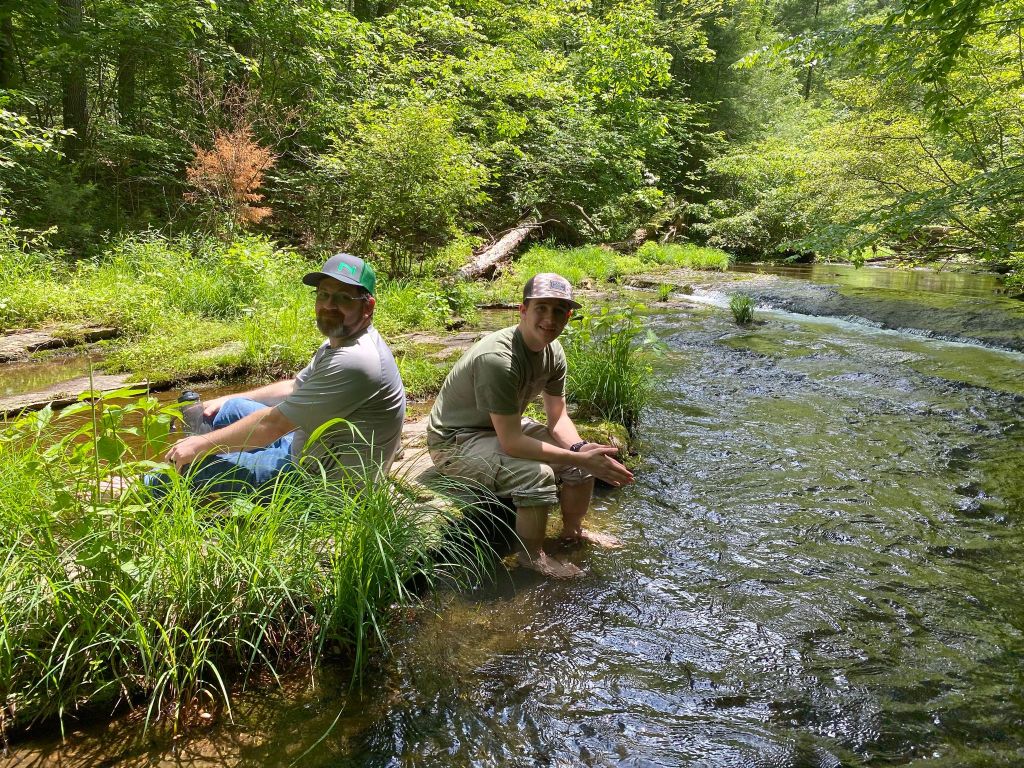
About 3 or so miles in we had descended to the river and left the trail, stripping our socks and shoes to walk in the cool water. We shared our refreshing respite with a young coon searching the bank for a snack in the shade on the opposite side. The water was cool and refreshing, both to our feet and our bellies. We employed 3 different water filtering systems which we had individually packed in to determine which was the most convenient. Personally, I think my Sawyer takes the win!
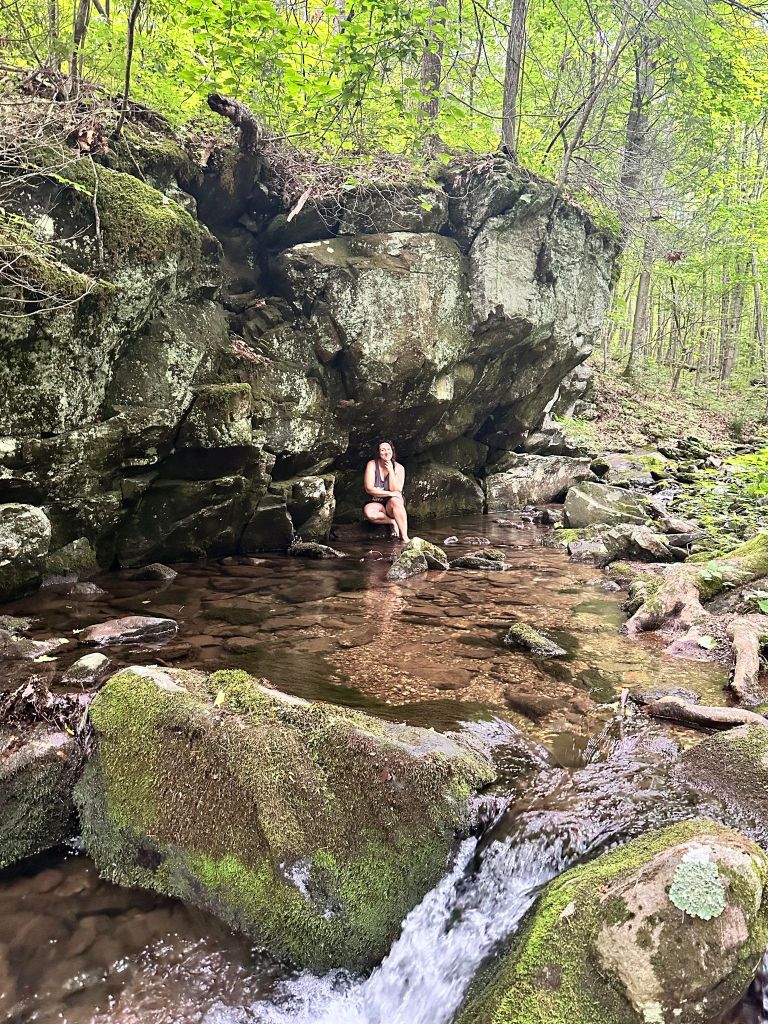
By this time there were no outside world noises, no cell service, no car noise or sirens, no crowds, just us and the wild! We walked along that river nearly 3 more miles before we made camp, getting to observe a turkey hen and her brood of chicks who crossed and scattered directly in front of us. We observed many deer and a deer and her fawn browsing upon the lush vegetation. We lost all of the outside world and immersed ourselves in our surroundings making camp in a bend of the river near a series of small waterfalls that lulled Shaun to sleep faster than a box fan could ever hope to accomplish. We explored the bends, the rocks and cliffs, we observed the birds, the bugs, and the canvas of sunset from our backs on the forest floor looking up through the canopy of poplar, occasional pine, birch, hickory, and sycamore. Shaun made sassafras tea, which smells like root beer, and we read books and listened to the roar of the water. We were still, we were in the moment, at rest and peace, feeling the slight strain in our muscles from the steep descent and the weight of our packs.
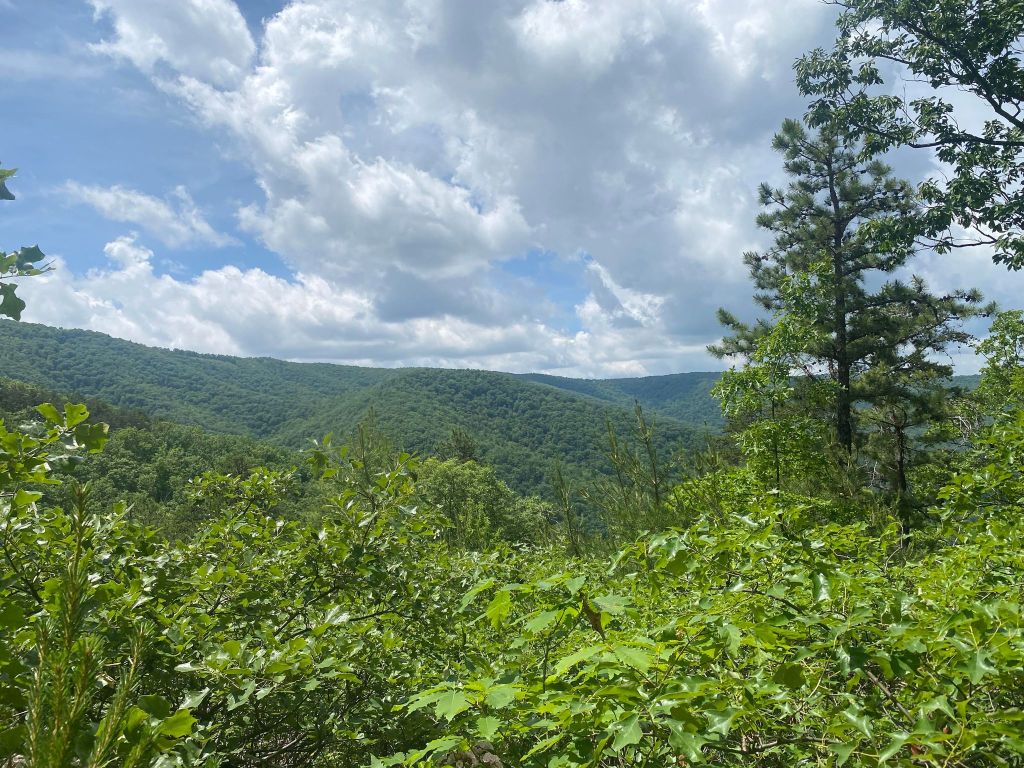
The next morning was much of the same, we awoke to the splendor of God’s creation singing its morning song. We packed up camp back into our packs, altered our route to come out a little earlier and avoid the storms that night and began our winding ascent. We were again arrested by the beauty of the mountain laurels which we discovered smell as wonderful as they look and certainly far better than us. Our legs were screaming by the time we finally topped out, but so were our souls. The views were incredible and the splendor restorative. There was no doubt in my mind that God has, in fact, made known His existence through creation as Paul wrote in Romans chapter 1.
Relaxation isn’t always laying around resting, for us, very often, its trying to find the limits of our body as we take in the splendor of creation and listen to its song. Therapy isn’t always talking, sometimes it’s laying on the forest floor saying absolutely nothing at all!




 Raychel Writes